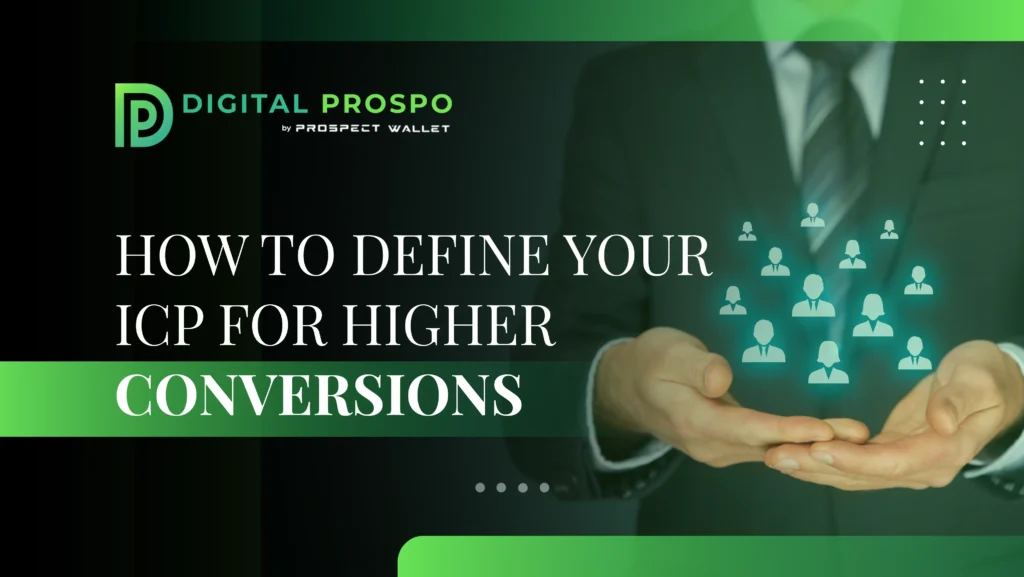
Defining your Ideal Customer Profile (ICP) is the foundation of a high-converting marketing and sales strategy. When businesses target the wrong audience, even well-planned campaigns fail to deliver results. A clearly defined ICP helps eliminate wasted effort by focusing only on prospects who are most likely to convert and generate long-term value.
An ICP describes the type of customer that gains maximum benefit from your solution while contributing the highest return on investment. It ensures alignment between marketing, sales, and revenue goals, making conversion optimization more predictable and scalable.
6 Key Factors That Define Your ICP for Higher Conversions
1. Why ICP Definition Directly Impacts Conversions
Conversions increase when your message reaches the right audience with the right intent. Without a defined ICP, targeting becomes broad and unfocused, leading to low engagement and high acquisition costs. A strong ICP brings clarity to your messaging and improves relevance across SEO, paid advertising, outbound campaigns, and sales conversations.
When relevance improves, trust builds faster. Prospects recognize that your solution addresses their specific challenges, which reduces objections and shortens the buying cycle.
2. Analyze Your Highest-Value Customers
The most accurate ICPs are built using data from existing customers. Focus on clients who convert quickly, stay longer, and deliver consistent revenue. Studying these customers helps identify patterns that can be replicated across future campaigns.
Pay close attention to factors such as retention behavior, engagement levels, and sales cycle length. These insights reveal which customer segments are naturally aligned with your offering and more likely to convert.
3. Identify Core Pain Points With Buying Intent
High conversions come from addressing urgent and high-impact problems. Your ideal customers are those actively seeking solutions, not those with casual interest. Understanding their challenges allows you to position your offering as a direct answer to a pressing need.
When pain points are clearly defined, your messaging becomes more persuasive. This clarity improves performance across landing pages, email campaigns, and sales outreach.
3. Define Firmographic and Behavioral Attributes
This is one area where bullet points improve clarity and scannability, especially for B2B audiences.
A strong ICP typically includes firmographic attributes such as:
Industry or niche focus
Company size and revenue range
Geographic location
Organizational structure
Behavioral attributes further refine targeting and include:
Buying readiness and urgency
Budget alignment
Engagement patterns
Decision-making authority
Combining these attributes ensures your marketing and sales efforts focus only on qualified, high-intent prospects.
4. Understand the Customer Buying Journey
Knowing how your ideal customer evaluates and purchases solutions is critical for conversion optimization. Some buyers require extensive research and internal approvals, while others move quickly once value is clear.
Aligning your content, follow-ups, and offers with this decision-making process reduces friction. When prospects receive the right information at the right time, conversions happen more naturally.
5. Align Your ICP With Your Core Value Proposition
Your ICP should directly reflect the customers who benefit most from your solution. Targeting audiences that fall outside this alignment leads to lower engagement and poor conversion performance.
When your ICP and value proposition are aligned, your messaging becomes more focused and outcome-driven. This improves ad relevance, website engagement, and lead-to-customer conversion rates.
6. Refine Your ICP for Continuous Growth
An ICP is not a one-time exercise. Market conditions, competition, and customer expectations change over time. Regular evaluation helps ensure your targeting remains accurate and effective.
Use campaign data, sales feedback, and customer insights to refine your ICP. Continuous optimization keeps your conversion strategy competitive and sustainable.
How a Defined ICP Drives Higher Conversions
A well-defined ICP improves every stage of the revenue funnel by increasing lead quality and reducing wasted spend. It strengthens messaging consistency, improves sales efficiency, and enhances overall customer experience.
When marketing and sales operate around a shared ICP, conversions increase and growth becomes more predictable
Conclusion
Defining your Ideal Customer Profile is a strategic move that directly impacts conversions and revenue. It enables smarter targeting, clearer messaging, and stronger customer relationships. Businesses that prioritize ICP clarity gain a measurable advantage in lead quality, conversion rates, and long-term scalability.
FAQs
1. What is an Ideal Customer Profile (ICP)?
An Ideal Customer Profile (ICP) defines the type of customer or business that is most likely to benefit from your product or service while delivering the highest value to your company. It includes firmographic, behavioral, and intent-based attributes that help improve targeting and conversions.
2. Why is ICP important for higher conversions?
ICP is important because it ensures your marketing and sales efforts focus only on high-intent prospects. When your messaging aligns with the right audience, engagement increases, sales cycles shorten, and conversion rates improve significantly.
3. How is ICP different from a buyer persona?
An ICP focuses on who to target at a company or account level, while a buyer persona focuses on who you talk to within that company. ICP defines the right fit for your business, whereas personas help tailor messaging to individual decision-makers.
4. How do you define an ICP for B2B businesses?
Defining a B2B ICP involves analyzing your highest-value customers, identifying common firmographic traits, understanding buying behavior, and mapping pain points that directly influence purchase decisions. Data-driven insights are critical for accuracy.
What is an Ideal Customer Profile (ICP)?
An Ideal Customer Profile (ICP) defines the type of customer or business that is most likely to benefit from your product or service while delivering the highest value to your company. It includes firmographic, behavioral, and intent-based attributes that help improve targeting and conversions.
Why is ICP important for higher conversions?
ICP is important because it ensures your marketing and sales efforts focus only on high-intent prospects. When your messaging aligns with the right audience, engagement increases, sales cycles shorten, and conversion rates improve significantly.
How is ICP different from a buyer persona?
An ICP focuses on who to target at a company or account level, while a buyer persona focuses on who you talk to within that company. ICP defines the right fit for your business, whereas personas help tailor messaging to individual decision-makers.
How do you define an ICP for B2B businesses?
Defining a B2B ICP involves analyzing your highest-value customers, identifying common firmographic traits, understanding buying behavior, and mapping pain points that directly influence purchase decisions. Data-driven insights are critical for accuracy.